
Deputy Humiliated and His Suffering Dismissed by Sherrif’s Office After Gun Range Mishap
Learn how Davis Law Group used 3D accident reconstruction to overcome defense bias and secure a $30M verdict for an injured deputy.
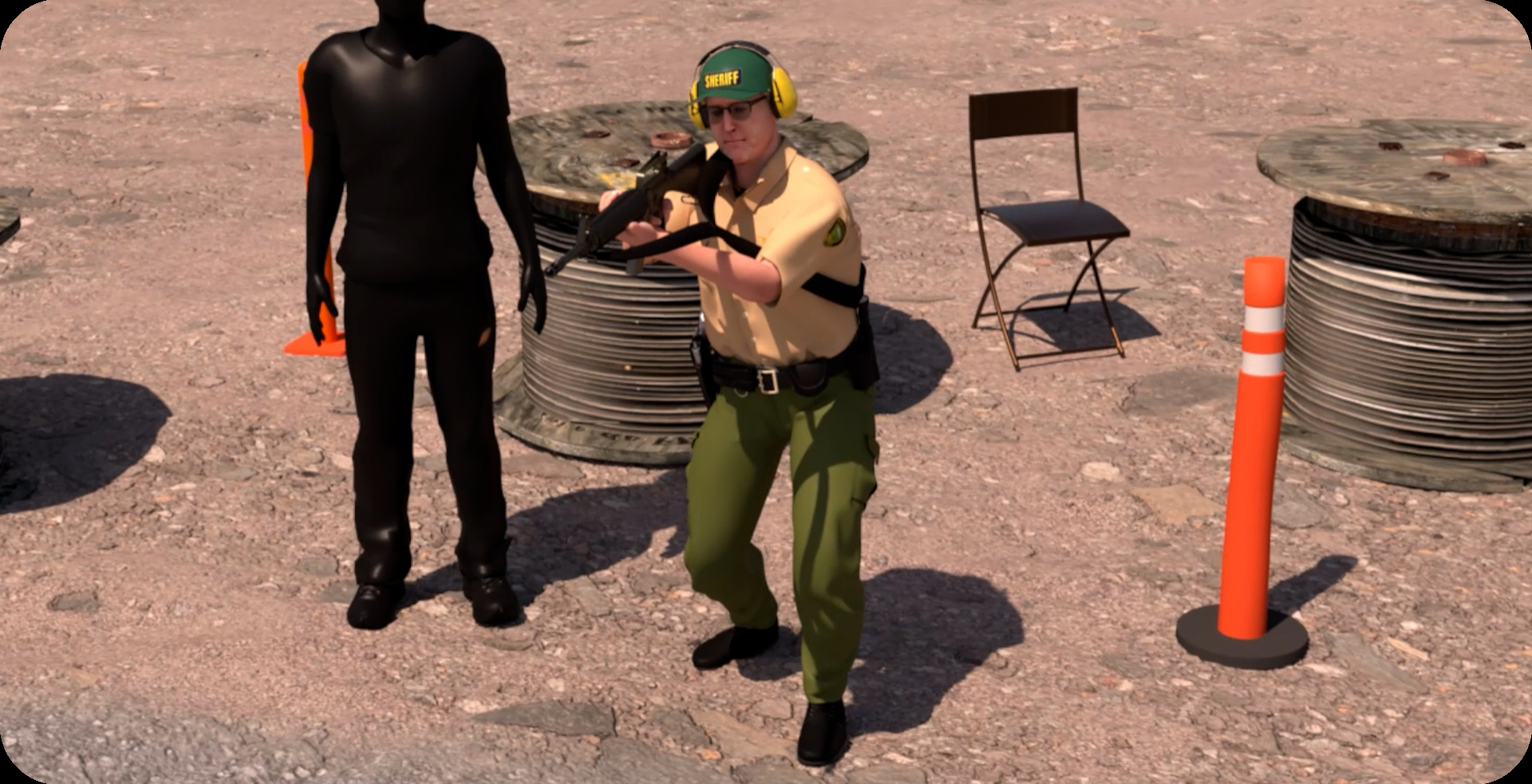
Watch the Case FeatureA rural county in Washington State required its deputies to complete an annual firearms qualification to carry their service weapon. As part of the exam, the sheriff’s office issued deputies an AR-15 rifle, a three-point sling, and bulky earmuffs. The drill required a deputy to fire the rifle from their dominant side, then transfer it to their support side. No other Washington agency used a three-point sling, let alone practiced the unusual maneuver. When 28-year-old Matthew arrived for his mandated training, he was not allowed to use his own sling, nor was he given the option to use foam earplugs. Instead, he was forced to use the range’s outdated sling and bulky earmuffs. Matthew performed the drill as instructed while a rangemaster and an instructor observed beside him. As he switched the rifle to this support-side, the three-point sling snagged on the earmuffs. The rangemaster opted not to intervene and watched silently as the deputy struggled to untangle himself. The rifle slipped from Matthew’s grasp. As he tried to catch it, the safety switched off and the weapon fired. The bullet blasted through the top of his foot at point-blank range, obliterating bones and blowing out his sole.
Matthew was rushed to the hospital. Surgeons attempted to salvage his right foot, but the bullet had shattered inside it. Bullet fragments intermixed with the decimated remnants of his cuboid, navicular, and metatarsal bones. Over the next four years, the deputy required 10 more painful procedures. His surgeons grafted skin from his thigh to the top of his foot to restore blood flow, but the graft failed. In the process, his foot ballooned up to the size of a football. Ultimately, to save his limb, he was left with no choice but to have his leg amputated below the knee. For the rest of his life, he would be forced to wear a prosthetic while suffering chronic pain. To make matters worse, the victim’s coworkers regularly ridiculed and humiliated him for having “shot himself,” hurling horrible insults at him during his years of recovery.
Matthew reached out to Chris Davis, founder of Davis Law Group, after hearing of another case the firm had handled. Chris had more than 33 years of litigation experience, and his firm focused heavily on litigating catastrophic loss and wrongful death cases. In most states, the deputy would have been forced into a workers’ compensation system. But Chris knew that Washington allowed its firefighters and law enforcement officers to sue their employers for negligence. Chris dug into the county’s safety rules and policies and found them to be unusual. Not only did the sheriff’s office mandate training maneuvers not used elsewhere, but it never evaluated them against current best practices as required by its own policies.
However, these troublesome findings did nothing to dent the county’s confidence. The defense felt they had no legal risk or exposure, and they doubled down on their liability position. They argued it was 100% the deputy’s fault for losing control of his rifle and pulling the trigger. Chris found overcoming this argument particularly tricky. He reached out to several firearm experts, and all of them placed most — if not all — of the blame squarely on Matthew. Chris understood that the image of the deputy shooting himself was viscerally overshadowing its critical safety context.
To nail the liability aspect, Chris retained a number of law enforcement officers to attest that Matthew had been instructed in an unsafe maneuver. He also brought on DK Global to not only show the severity of the injury but to demonstrate the riskiness of the maneuver itself. Chris needed a jury to see exactly how the complicated 3-point strap had tangled with the deputy’s obstructive earmuffs. He also understood how powerful it would be to show what should have happened instead if the county hadn’t been negligent.
The six-minute animation opened with an overhead reconstruction of the firearms training facility. It presented a 3D recreation of the incident in real time, showing Matthew struggling with the strap catching on his earmuffs and how he looked to the rangemaster for help. Then, a replay of the animation dissected critical failures during the incident. Meanwhile, the rangemaster could be seen two to three feet from the deputy, as the safety officer was only ten feet away. After that, the gun went off. Next, the animation zoomed in to reveal the damaged foot. At this point, a 3D reconstruction of the foot showed the bullet and bone fragments and compared them against the medical imaging. Following this, photos were displayed of the range and of the deputy's wounded foot. Finally, the animation concluded with a hypothetical reenactment that showed the rangemaster intervening during the struggle.
The defense’s posture never wavered leading up to trial. Even after a full day of mediation, they refused to extend any offers. At trial, they were so confident that they elected not to put their two damage experts on the stand. After a couple of days of testimony, the county finally made a single offer of $150,000, which Chris rejected. Then, Chris showed the animation to the jury. After watching, the jurors began asking questions that signaled to Chris they were sympathetic to Matthew. Consequently, Chris offered to settle the case for $10,000,000. The county ignored it. So, the parties waited for the jury to return with a decision. When they finished deliberating, the jury returned a gross verdict of over $30,000,000 for Matthew — a satisfying comeuppance to the county that had bullied him for years.
Chris Davis, founder of Davis Law Group, has been a civil litigator for over 33 years, representing victims in catastrophic injury and wrongful death cases. He has won numerous multimillion verdicts and settlements on behalf of his clients. Throughout his career, Chris has been recognized as one of the "Top 10 Personal Injury Attorneys” in WA, a 10.0 "Superb Lawyer" by Avvo, and a "Super Lawyer" by Super Lawyer Magazine. His firm was recognized as the "Best Personal Injury Law Firm" in WA, 2015-2020, by AI Dispute Resolution Rewards. He has also authored books on injury law, including the Washington Accident Books series.
DK Global definitely is the go-to exhibit creator, animation creator that we rely on.
 Animation
 Animation